GOOD NATURE - JILL TAYLOR
JILL TAYLOR: Puffins…they have…the best way I can describe it is they sound like an angry chainsaw, but like, a really small angry chainsaws.
MEGAN LESLIE: I regret asking this question.
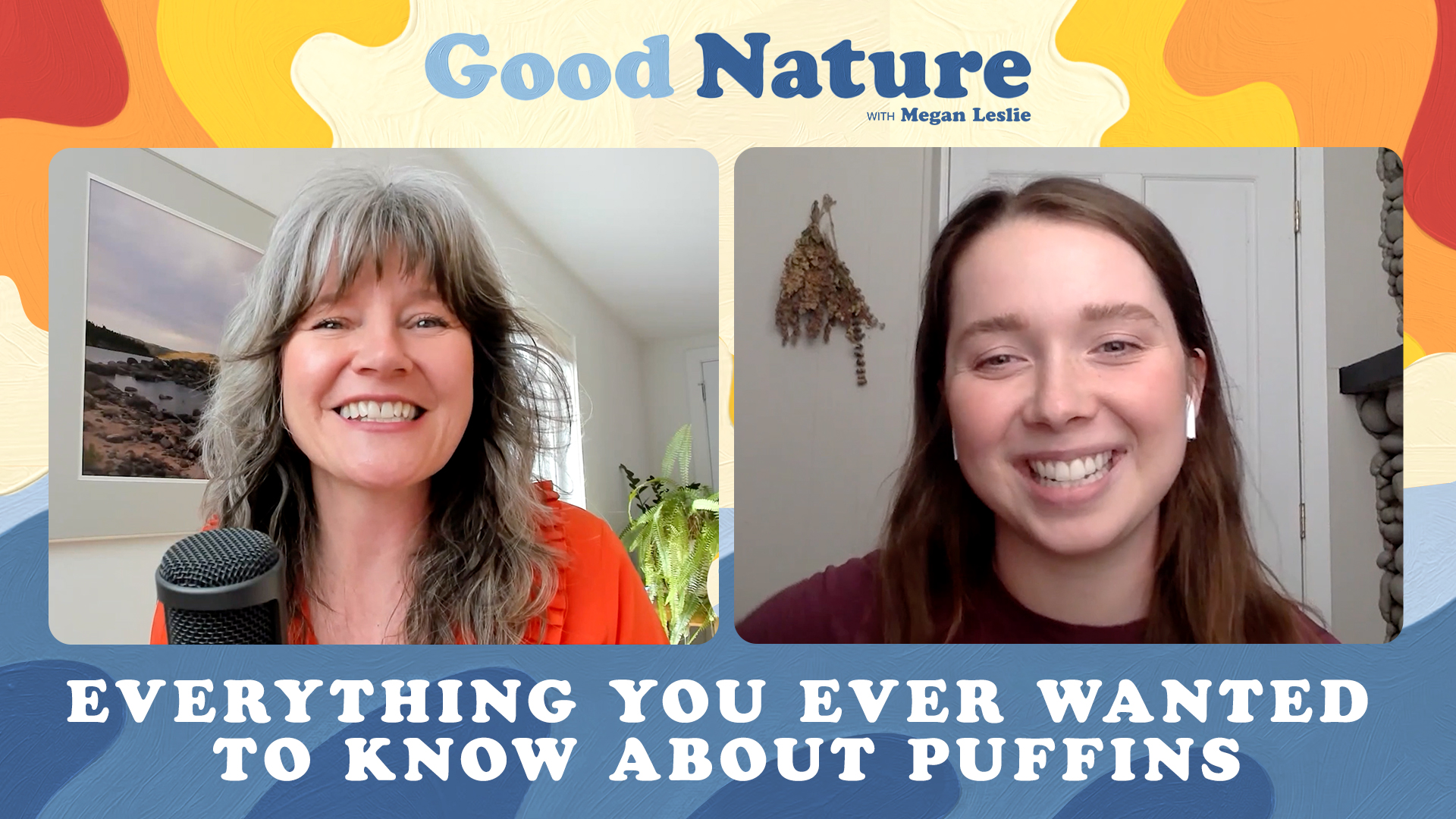
MEGAN LESLIE: Hello, and welcome to Good Nature. I'm your host, Megan Leslie. In each episode of this podcast, we talk to the people who give me hope for the future of nature and wildlife. And today, we're talking about puffins! Yes, puffins, that charismatic little seabird, the Atlantic puffin, and we're chatting with our guest, science communicator and puffin researcher, Jill Taylor. Jill has racked up hundreds of thousands of views on social media, where she posts about puffin antics, the beauty of Atlantic Canada, and her adventures scuba diving off the coast of her home province, Nova Scotia. Jill is so enthusiastic about what she does and she is a real ambassador for Atlantic Canada. It was an absolute delight to talk to her. But before we talk to Jill, it's time to check in with one of my WWF-Canada colleagues, who has a bit of a nature hot take to share with us.
MEGAN LESLIE: This is the part of the show where we discuss ideas about nature and conservation that maybe we haven't questioned before. And today, we're using the orca phone to check in with WWF-Canada's resident botanist, Ryan Godfrey. Ryan, I hear you have a nature hot take for me. Let's hear it.
RYAN GODFREY: I do, Megan. I have a hot take, but I have to warn you first. This is a very hot take. Like a red hot sizzling hot take Are you ready for it?
MEGAN LESLIE: Sizzling. I love it. Go for it.
RYAN GODFREY: So, I live in a city, I am part of the urban ecosystem, and I'm going to advocate that there's another creature that belongs in the urban ecosystem and one that not everyone may appreciate all the time, and that would be a four-legged furry friend called a coyote.
MEGAN LESLIE: Yeah, people aren't, they're not into the coyotes being in the cities.
RYAN GODFREY: Yeah, it's true, not everyone loves a coyote. They can be a little scary at times, but they do really belong, Megan. And I'm gonna advocate, I'm going to make the argument that it's actually a good thing that we have coyotes as a top predator in our urban ecosystems.
MEGAN LESLIE: Okay, I think a lot of people are going to disagree with you, but explain .
RYAN GODFREY: I'm prepared for that, that's why this is a hot take. See, the thing about ecological restoration is we don't just want to restore simple ecosystems with just plants and maybe some bugs. We want complex ecosystems. And a complex ecosystem has many layers. We call those trophic levels. So you have the plants, then you have bugs that eat the plants. You have the birds that eat the bugs that eat the plants and then you wanna go up higher than that. So like on the bird side of things, you might have a hawk that eats the birds, that eats bugs that eats the plants. And on the mammal side of things, you know, you have bunnies and squirrels and then you gotta have something above that to eat and control.
MEGAN LESLIE: Do we, Ryan? Do we?!
RYAN GODFREY: We do, Megan, we really do. It's ecosystem health, it is resilience, it's-
MEGAN LESLIE: It’s nature.
RYAN GODFREY: It's nature. It's nature. It’s the circle of life. And the coyotes are doing that in a beautiful way. These Eastern coyotes are actually a novel species, they're a hybrid, comprising genetics from an endangered Eastern red wolf along with Western coyotes.
MEGAN LESLIE: No way.
RYAN GODFREY: There's a little bit of domestic dog mixed in there. Sometimes there's a little bit of gray wolf mixed in. So they’re a species that hasn't been seen on the landscape prior to European colonization. But now they're here. They're doing their thing. They are thriving in urban ecosystems and they're doing such an important function. And I think that we should learn to coexist with them.
MEGAN LESLIE: Well, you've convinced me. I agree. Thanks for that really great hot take.
RYAN GODFREY: Cheers!
GRAPHIC: JILL TAYLOR, PUFFIN RESEARCHER & SCIENCE COMMUNICATOR
MEGAN LESLIE: Today on Good Nature, I am chatting with Jill Taylor, a researcher, underwater videographer, and science communicator based in Atlantic Canada. Jill is an expert in what she calls North America's most charismatic seabird, the puffin. Jill, thank you for joining us on Good Nature today. I am so excited to talk about puffins with you. It's gonna be great!
JILL TAYLOR: Thanks so much for having me, Megan. I'm very, very excited to chat about, yes, the world's most charismatic seabird, the Atlantic puffin.
MEGAN LESLIE: Most charismatic. So Jill, Canada's home to a lot of iconic species, right? We've got the narwhal, which is the unicorn of the sea. We have caribou with their stunning migration across the tundra. Grizzly bear, a symbol of wild spaces. And then there is this funny little bird that, to me, looks like a flying potato. So the puffin. Jill, please describe the puffin for us.
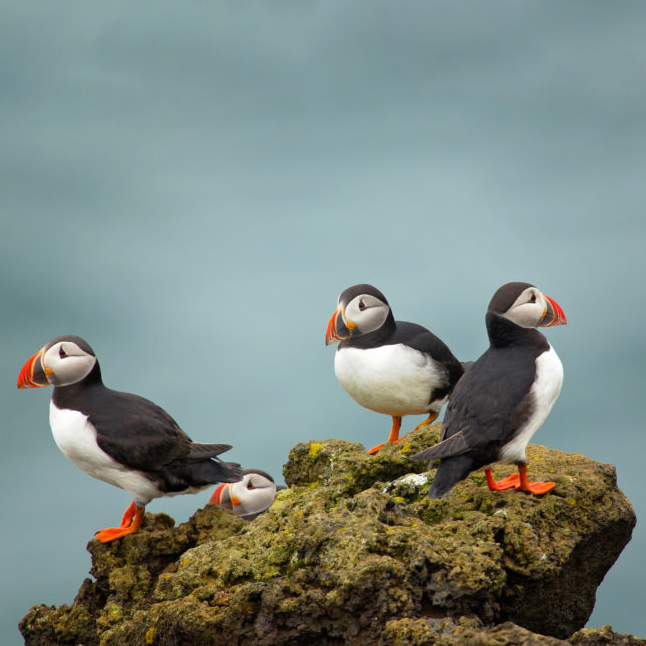
JILL TAYLOR: You're not that far off. They are pretty much like flying potatoes. They have a pretty short wingspan for their size, so they have to flap really fast to be able to stay in the air. But yeah, the Atlantic puffin, very small seabird. Typically smaller than what a lot of people think they are. I think zoom lens photos distort the size, maybe a little, and people think they're going to be the size of penguins, but they only sit at about the size of…just under a ruler, so just under 30 centimeters. A big potato, but a small sea bird!
MEGAN LESLIE: Yeah.
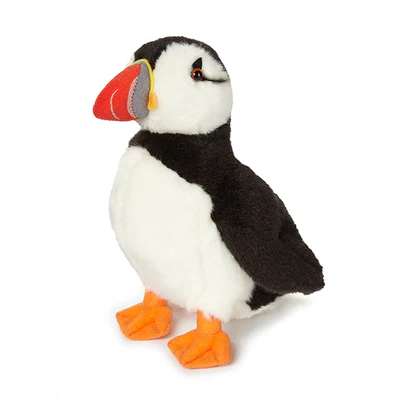
JILL TAYLOR: And yeah, they have this classic black and white contrast, but the big beautiful bill, this bright orange bill that comes through in the breeding season is the iconic part of their look. They look like they're wearing little tuxedos and they have lots of funny names. I think they've been called sea parrots. Their Latin name translates to Little Brother of the North.
MEGAN LESLIE: Oh my gosh.
JILL TAYLOR: Hatchet Face, I think, is another name for them. So yeah, they've got some nicknames, that's for sure.
MEGAN LESLIE: Little brother of the North, that is a winner. So the first time I ever saw a puffin, I was with some WWF supporters. We were on a seabird cruise in Bay Bulls, Newfoundland, you know the one. And I kind of thought we'd go out on the water and the guide would be like, look, there, there is a puffin, and over there, there is another puffin. I kind thought we’d just see one or two and holy cow, was I wrong! ‘Cause they're in, they're in colonies. Can you paint us a picture of a puffin colony? What does it look like and sound like?
JILL TAYLOR: Mm-hmm, for sure. Well, first of all, I'm just, I'm glad that you've been so, you know, exactly what I'm describing. You've seen this with your own eyes. Yeah, there's there's definitely more than one or two in these colonies The first thing, for those who've never been to a seabird colony, you often smell them before you see them. So there's this unique smell. It's good that there’s a sign of activity and it means that they're hunting for fish and they have food to eat. But there's like, uh, a bit of a stinky fishy smell to it. A little bit of like a seaweed, dried seaweed on the beach kind of smell, but there's also this, like, sickly sweet smell on top of that as well, which I think is the best way to describe a lot of birds all coexisting together. But oftentimes these are in the North Atlantic. They're often really foggy days. So sometimes you'll actually smell them before you actually physically see them in the fog.
MEGAN LESLIE: I remember that. Yeah.
JILL TAYLOR: Yeah. Yeah. I'm sure that smell would take you right back. But yeah, a lot of these islands are these steep, steep rocky cliffs with the peaty soil on top with lots of grass and muddy slopes. And these seabirds select these islands so that they're away from predators. So they're out of harm's way from other land mammals that could dig up their young or their eggs, like foxes and mink and otter and other animals like that. But then it's just the sheer volume of activity is really probably the most amazing thing that you get to see.
MEGAN LESLIE: Okay.
JILL TAYLOR: Once you've gotten over the smell, you're seeing there's activity above you, there's all this overhead traffic. I'm still unsure how they don't all just collide into each other all the time. And then there's activitY on the water. There's lots of birds, What we call rafting, is when they float on the surface. And then, there are lots of birds below that are constantly diving down and ducking down to find food and to fish. And the specific colony that I've worked on is in Witless Bay Ecological Reserve. So that is the largest puffin colony in all of North America, second largest in the world. And we're talking about over a million seabirds from nine different species in the summer breeding months.
MEGAN LESLIE: Just in this one area.
JILL TAYLOR: Yeah! And so yeah, this, this reserve itself is a collection of four islands. So that has spread out, but still, a million of anything is a lot to quantify.
MEGAN LESLIE: Wow. Yeah, no kidding. You know, you talked about the activity. And so, I was on a boat. I was several hundred meters away from the island and that activity, holy smokes, like there was all this whirring. I have videos of the puffins whirring above me. And it felt like they were whirring along the surface of the water and they were just everywhere. It felt like, they were dropping. I mean, they weren't dropping. But it felt like they were dropping from the cliffs and dropping from the sky and popping up from the water. It's incredible activity.
JILL TAYLOR: Mm-hmm, it really is. Yeah, you'll often, like puffins themselves don't have like a specific song like a lot of birds we think of, they have like specific call. So the puffin portion, they do make sounds, but it's very quiet relative for any kind of bird nesting activity. And so often you just hear the flapping of their wings because they're flapping so hard, so you hear the whoosh whoosh. And then, but yeah, they're dropping off the cliffs all the time, they're not the best flyers, so they often will waddle up and climb up to the top of these cliffs and let gravity do your work for them. But yeah, there’s lots of—I've seen puffins surfing waves. They seem to be quite playful. And this is all coexisting with the other seabirds that they're living with, that are their neighbors. You have the puffins that are on the grassy burrow slopes where they've dug out all their burrows. And then you have the rocky cliffs where all the kittiwakes have their eggs on the edge of cliffs and you're like, how do these not roll off? And then you have the murres and you have the razorbills and then you have other gull species and the bald eagle couple that scares everyone when they make their rounds around the island. So there's a lot going on.
MEGAN LESLIE: Oh, yeah, yeah. They're coming! Yeah. I also want to know, like we've been talking about them being kind of adorable and a bit silly and clumsy. So there's a bit of a caricature about them. What do you wish that people understood about puffins kind of beyond their reputation?
JILL TAYLOR: I think in general, they have a fairly good reputation in that they're known as being cute, like you just said. They're a huge driver for tourism in the province. They are a provincial bird in Newfoundland and Labrador.
MEGAN LESLIE: Oh, I didn’t know that!
JILL TAYLOR: And yeah, they're on people's bucket list to see them. People make trips to Newfoundland just to see them. And I think a lot of people don't realize you don't have to go to Iceland to see puffins. You can see them right in Canada, which is really special. But yes, obviously known as very cute. People want to get their photos and say they've seen a puffin and all that good stuff. I think in general, we have maybe a misconception as humans that birds kind of have this “bird brain” or they're not that smart.
MEGAN LESLIE: Oh yeah!
JILL TAYLOR: And they're kind of dumb or silly. And we love as humans to do this hierarchy where we're at top and we're the most intelligent. I don't even think that's a good word to use, but the smartest at the top. And then we rank all these other animals based on, could they make an Excel spreadsheet and could they go to do taxes and stuff like that, or go to the moon?
MEGAN LESLIE: Can puffins do taxes?!
JILL TAYLOR: Newsflash, they cannot, unfortunately.
MEGAN LESLIE: Oh, okay, I figured, yeah.
JILL TAYLOR: Good for them though, they got an escape.
MEGAN LESLIE: They would try hard!
JILL TAYLOR: They would. But I think a lot of looking at any sort of wildlife is looking at their environment and their habitat and what they needed to evolve to be able to do to be successful in that environment. And one thing that puffins, they do very well in the water and are very comfortable. They can dive up to 60 meters. They're very agile in the water. But they make these large migrations where they spend the winters away from their islands out at sea. And then they make it back to the same islands every year, which is incredible. Without a GPS, I surely could not do that. And I think another incredible part of that is not only do they make it back to those islands, they also make it to the same burrow every year. And if they can't get that exact burrow, they'll stay within a two meter radius of that burrow. So their directional skills are very impressive.
MEGAN LESLIE: And they're real specialists. They know what they're, yeah, they've evolved to be exactly what they needed to be.
JILL TAYLOR: Exactly. They know how to do what they need to do.
MEGAN LESLIE: Yeah. So Jill, at WWF-Canada, we do a report called the Living Planet Report Canada, sometimes we call it LPRC, and it comes out from time to time and it really reports on the state of wildlife populations across Canada. And, you know, spoiler alert, they're not doing well. On a global scale, we know that Atlantic puffin numbers are in decline, but we even put them on the cover of our 2020 report, because here in Canada, the puffin populations are rising. Can you tell us a little bit about why that is?
JILL TAYLOR: Yeah, so the Atlantic puffins globally are on the IUCN Red List, so they are considered, I think, vulnerable. And that is large in part to the populations in Iceland have taken a hit in recent years.
MEGAN LESLIE: And that list is like this international species at risk list.
JILL TAYLOR: Yes, exactly. What it comes down to is globally, if they're at risk, I mean, you can say this almost about every species, but climate change is a large pressure. And that is something we have to acknowledge that we're seeing warmer water temperatures, warmer ocean temperatures, and a lot of the forage fish that puffins rely on to feed themselves and to feed their young are seeking cooler waters. And they've only evolved to dive so deep, they're really good at diving. But if these fish are looking for colder water, these puffins have not yet evolved to be able to dive as deep to get the fish that they need.
MEGAN LESLIE: Fascinating.
JILL TAYLOR: And this often looks like they actually have to travel further to get the fish that they need, which means they're expending more energy, they're more tired, they're maybe not making it back to feed their chick enough or feed themselves. Another part of that fish problem is that anthropogenic reasons is that overfishing does deplete these fish stocks. Even in Canada, so in Newfoundland, puffins, their two favorite fish that they're eating are sand lance and capelin, which are both very important fish for the ecosystem.
GRAPHIC: “Capelin are small, silvery forage fish that “roll” onto the beaches of Newfoundland and Labrador (and some parts of Quebec) every summer to spawn. They’re a major food source for Atlantic cod, humpback whales and many seabirds—including puffins!”
JILL TAYLOR: The capelin roll every year is this really magical thing. The humpback whales come up to chase the capelin. The cod are chasing capelin. The puffins are chasing the capeline. Capelin are amazing. But even historically, we're seeing the capelin fishery does still exist, and I think the capelin stock is at like 9% of its historical biomass. So definitely a little concerning there.
MEGAN LESLIE: Yeah.
JILL TAYLOR: But yes, within Canada, the populations seem to be fairly stable and good. Like I want to knock on wood that things can change so quickly. I want us to see hopefully that they continue to do okay. This is why we have scientists like myself and other colleagues who are out monitoring these populations every breeding season to make sure we know what's going on with the puffins and are able to respond if anything does change. So again. Always something to keep in mind of, but we definitely, those same pressures do face the Canadian puffins, but I think there's just a few less of those pressures added on.
MEGAN LESLIE: Well, can I ask you, because I thought there was, it had something to do with bycatch as well, so this idea that when you're fishing with nets, you are fishing for a specific fish species, but you catch other things, and wasn't there, maybe a bit more past tense, wasn't their an issue around puffins being caught as bycatch as well?
JILL TAYLOR: Yeah, that's definitely always a risk. I know I had some colleagues who were working on looking at ways to deter birds from coming into where they were netting fish. So using like fake avian predators of like fake gulls or eagles on fishing vessels to see if that could deter, kind of signal to birds of like, oh, stay away, don't come in this area.
MEGAN LESLIE: Interesting.
JILL TAYLOR: Definitely, definitely always at risk. And so yeah, all of these things can impact puffins for sure.
MEGAN LESLIE: So, that example you used of fake predators to keep the puffins away so they don't end up caught in these nets, that is a conservation action. It is taking action to prevent accidentally killing some of these birds. That is also an action that is really specific out there in the ocean happening on fishing vessels. Are there actions that we can take in the broader coastal ecosystem to support them as well? Like, what are some of the actions we could take?
JILL TAYLOR: Yeah. We now have evidence that—we had thought this to be true, but we didn't know for sure—that puffins were attracted to artificial light at night. ALAN is the acronym there.
MEGAN LESLIE: Oh yeah. I've heard of this.
JILL TAYLOR: When puffins fledge, so they fledge in Witless Bay Ecological Reserve mid to early August every year. Basically, they're kicked out of the burrow. We think that puffins likely use the moon as some kind of navigation at night, but sometimes they'll mistake that coastal light in cities that are close to the colonies and head in towards these cities instead.
MEGAN LESLIE: Uh oh.
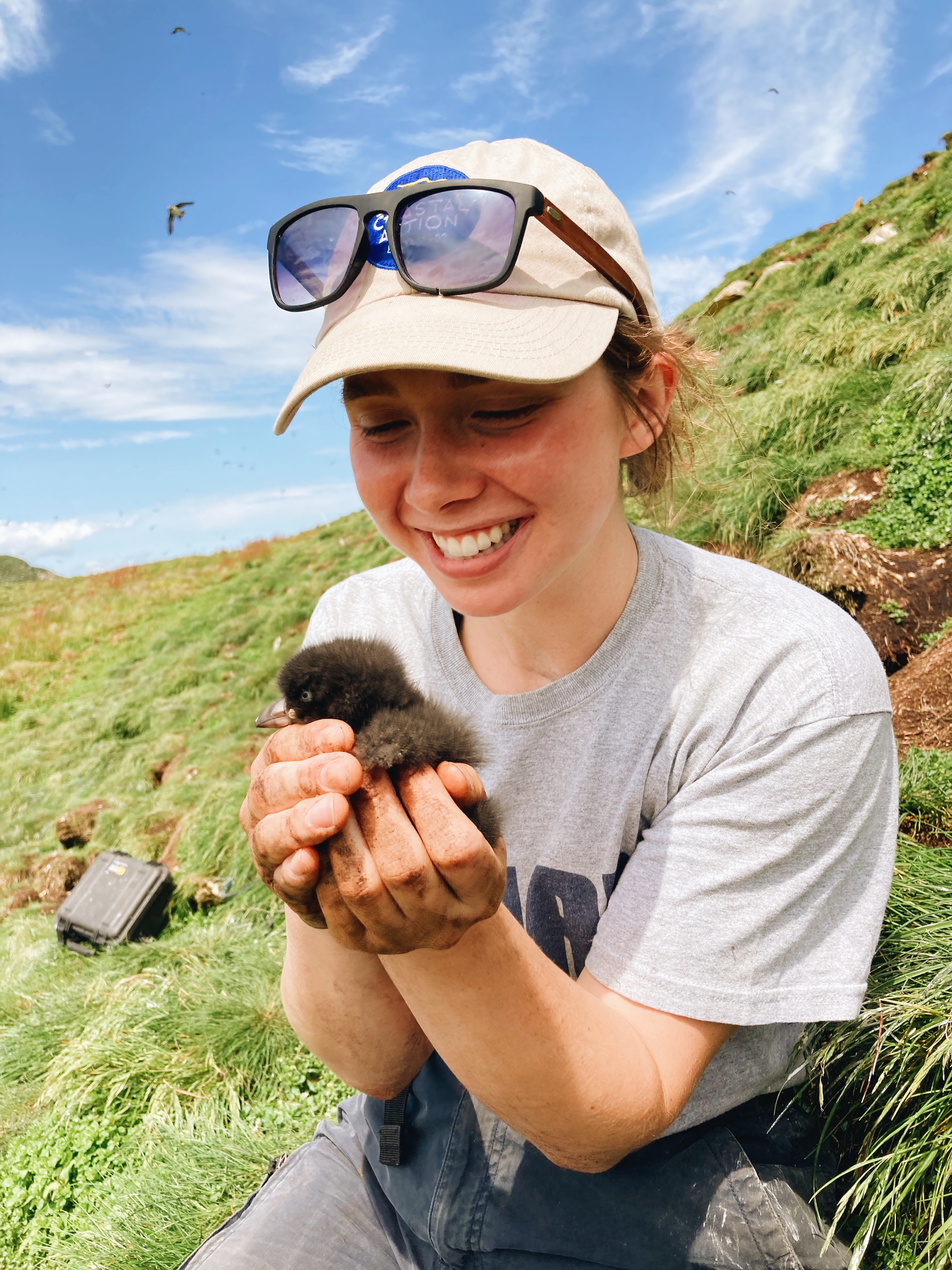
JILL TAYLOR: Which puts them at risk because they become stranded there. They're not able to get food. And then there, there's predators like outdoor cats, foxes, even large rats, like these fledglings are not that big. So that risk, then, for being predated, which is unfortunate. So your question was, what can we do? Well, this is a two-fold question. Answer is that there is this really lovely program called the Puffin and Petrel Patrol. So every year, in August, near these coastal areas, you can volunteer if you're there in the area, even if you are visiting as a tourist, you can take your family, kids are more than welcome, and you can sign up and you basically take your headlamp, you go out when it's night. And you'll go around and find if there's any fledglings or pufflings in the area.
MEGAN LESLIE: So good.
JILL TAYLOR: And then the organizers take them and then they release them the next day or the next few days out on the water and they get to go live their merry life and hopefully do well and use the moon for direction instead of the city lights.
MEGAN LESLIE: I love that.
JILL TAYLOR: But another part of that is even just being mindful of the sorts of, if you live on a coastal place, not even just where puffins are, but lots of seabirds who know are attracted to artificial light at night. Is that just being mindful of what kind of shed lights you have on, if you have lots of porch lights, like maybe you have a lot of pot lights around and you have like eight and it's really bright, it's like, okay, maybe you don't need that on at night after a certain point if you're going to bed, like shut those off. I know there's lots of work in the works to look at even like grocery store parking lots and other like larger infrastructure buildings, like schools and. And street lights to look at like the angle of the lights. I think there's works to maybe, if they're angled down at a certain way, they're less attractive to birds or other wildlife that might confuse them for something else.
MEGAN LESLIE: That’s awesome. Jill, I want to switch gears a little bit. You have spent a lot of time on land with puffins, but you also post a lot about your adventures scuba diving off the coast of Nova Scotia. And I can only imagine that spending so much time underwater must give you a whole new perspective. And I'd love to ask you, how does that change the way you see the places that you study?
JILL TAYLOR: I think it helps me see the full picture almost in that there is a whole other world that exists under the surface that not a lot of people get to see. We live, especially if you live on the coast, like a lot humans do in the world live by the coast. It's like this whole other, it feels like the closest you could get to going to outer space while staying on the same planet. And especially with puffins, I think maybe I didn't know this yet, but I was scuba diving before I researched puffins and puffins are really good divers. So. Maybe that's part of what drew me to them as well. But getting to see that underwater portion of their life because it's such a big part of their lives and how they get food and how they live and exist in this habitat is really cool to me. And I have seen puffins, not overly common to see them, but I have them on a few dives which is cool to see them under water and they zoom away pretty quickly. But to get a glimpse is really special.
MEGAN LESLIE: I imagine. Do you have a moment from one of those dives that really sticks with you?
JILL TAYLOR: I don't know. I can never pick one. There's so many special moments. I think all of them kind of accumulate to being really special. I think even this past summer, getting to see wild Atlantic salmon in the ocean.
MEGAN LESLIE: Oh my gosh.
JILL TAYLOR: The first footage of wild Atlantic salmon in Canada. We know a lot about their freshwater portion of their life cycle, but in the ocean, it's really hard to see them, like a needle in a haystack, a really, really big haystack. They're even just like little things too, like diving and taking a moment to slow down and see and appreciate the smaller invertebrates and the more, the macro things around us, like sea slugs. Nova Scotia and Newfoundland are really good for seeing sea slugs. Yeah, it's been more of like a treasure hunt to try to find them. You definitely have to use your, I don't know what the word is, your detective skills a little bit, but makes it more rewarding.
MEGAN LESLIE: Yeah, no kidding. I am so glad that you brought up sea slugs. Not a sentence I ever thought I would say. But I love watching your videos because I think that your joy for what I would call the creepy crawlies, your joy for creepy crawlies really shines through. And if I were ever swimming and saw a sea slug, if you ever told me that I would see a sea slug while swimming, I would probably freak out. But when I see your videos, I see... The beauty in them, I see how special they are. And like, I want to be a sea slug champion. So when, I just wonder, when you're making these videos, when you’re trying to bring these stories to life for people, what's going through your mind? What are you thinking about?
JILL TAYLOR: Well, first of all, I'm glad to say we've maybe converted another person to being a sea slug fan.
MEGAN LESLIE: I'm there. I'm there.
JILL TAYLOR: Yeah, I think slugs in general, again, puffins really sell themselves. They don't need any help with their PR because everyone thinks that they're cute. I think a lot of things that live more under the ocean, even fish, I feel like people don't think are cute, but I think it just speaks to the amazing biodiversity that we do have in Atlantic Canada. I think other parts of the world, obviously, tropical ecosystems underwater, like coral reefs, like everyone loves a coral reef. We know those are beautiful. We've seen really beautiful imagery. That's amazing. We should keep appreciating them. But I feel like Atlantic Canada doesn't get the same amount of attention for the beauty that we have here.
MEGAN LESLIE: You’re right. You’re right.
JILL TAYLOR: And yes, like I said, it's not as flashy. Maybe it's just not quite in your face. You have to look a little harder for it. But I do think that makes it more rewarding. And I think it's a little maybe more incognito, but we do, we have. We have bright red and pink sea slugs that are hiding out. And another really cool dive that comes to mind is a photosynthetic sap sucking sea slug, the Eastern Emerald Elysia, which is found in Nova Scotia.
MEGAN LESLIE: Oh, okay.
JILL TAYLOR: So cool that we have this weird blend of like plant to animal that we have. I wish I could photosynthesize. I think that's so cool. They steal chloroplasts from the algae that they eat and they can incorporate it into their own cells and steal energy from the sun. Like the fact that we have this wide variety of abilities in these animals. Yeah, there's so much to appreciate.
MEGAN LESLIE: You know, you're right, it's not as flashy on the Atlantic coast, but I wanna thank you because I have learned that it's a lot flashier than I thought. It's definitely a lot flashier than I thought. And so I think about your audience and probably when you're doing science communication like this, it’s a great tool for, on the one hand, you can meet skeptics where they're at. And on the other hand, you're providing content for people who are already engaged and interested. So it must be a real range of audiences that interact with your work.
JILL TAYLOR: Yeah, I think that's a good way to put it. I think in general I've been very lucky in that my work on social media, there's been a really just overall positive reaction to it. I think it's hard to hate on puffins. I think you'd have to be pretty cold-hearted to do that.
MEGAN LESLIE: I'll find them, and I will give them a stern talking, too.
JILL TAYLOR: Thank you. Thank you, Megan. But as for the scuba diving, I think an overall reaction and this is one I love getting over and over again is just people being like, I grew up here my entire life and I had no idea this was in my backyard. I love that. I think it's really empowering to be able to know the animals in your own backyard and to be able to go outside and name the species that you're looking in front of you. I think a large part of what drives me to share the way I do, I love being out in nature. I just am happy to film and capture that of the cool things that I'm seeing. I think a large driving force of this is that you really care about the things that you can name and we wanna protect the things that we care about. So I think in essence, that's really what, yeah, that’s really my driving philosophy.
MEGAN LESLIE: So yes, absolutely. We care about the things that we know and understand and can name. And I think you've done such a, it's obvious to me, the work that you do has really connected people differently to wildlife, to their environment. Have you ever seen some of your content like change the way that someone thinks or even acts about wildlife or conservation? Have you seen it in that context?
JILL TAYLOR: I think a lot of like the first step to conservation is the recreating part. So like if you're recreating in an area, then you're like, oh, I really, this is really important to me. I use this personally, like maybe I don't want it to be privately developed. Maybe I still want to be able to access it as a kind of public land. And I want the wildlife that I see and enjoy to be there when I go there and this area not to be degraded. So I think that's really the first step is that that personal piece of like, oh, well, I recreate here. So I'd like this to be protected. And I think that then continues onwards to other smaller conservation pieces, whether that means maybe people are, they're going to volunteer with conservation orgs that are important to them, or maybe that means voting in ways that they want to protect these natural spaces close to them that they want. I think a lot of what I get to see is just the joy of people seeing animals for the first time, or people being like, I've always wanted to see puffins, and then the follow up of, I got to see my first puffin this past summer, and I'm like, I'm so happy that you got to have this experience, and now we can bond over this puffin experience. So if puffins have to be the-
MEGAN LESLIE: “I got to see my sea slug this summer!”
JILL TAYLOR: Exactly. Yeah. I get to hear that, too. Yeah. I feel like the larger audience is more drawn by the puffins and then you have some more niche people that are like. I know what a sea slug is now-
MEGAN LESLIE: Niche people?!
JILL TAYLOR: And I saw one when I was out snorkeling or when I was out tide pooling or something like that.
MEGAN LESLIE: Awesome. Jill, thanks so much for this conversation. On this show, we actually end every interview with a bit of a lightning round series of questions that we call,
JILL TAYLOR: Oh okay!
MEGAN LESLIE: Oh yeah, it's the Trail Mix.
JILL TAYLOR: Okay, nice.
MEGAN LESLIE: So I'm gonna ask you a quick question and you've got to give me a quick answer. You ready?
JILL TAYLOR: Okay, I'm ready, Megan.
GRAPHIC: THE TRAIL MIX
MEGAN LESLIE: Okay, this is a lob ball for the first one, okay? Favorite puffin fun fact.
JILL TAYLOR: They don't look the way they do all year round. They lose parts of their bill. Their bill plates fall-
MEGAN LESLIE: No, they don't!
JILL TAYLOR: Yeah, they do. And the feathers around their eyes darken. When researchers were first studying them, they thought they were a completely different species, which I think is so fun that they had fooled them. But it's the same. The puffins just look different in overwintering. And then in the breeding season, they put a lot of energy into producing this bright orange bill. But yeah, they look really different. They look more goth in the wintertime.
MEGAN LESLIE: Well, that's a wrap because that blew my mind. We're done here. I did not know that. Thank you. This was supposed to be quick.
JILL TAYLOR: Do I get bonus points for being something you didn't know?
MEGAN LESLIE: Absolutely. Well, no, everybody knows a lot more than I do, but holy Toledo, I did know that! Okay, Megan, we've got to be quick here. So obviously, obviously puffins are the best sea bird. So what is the second best seabird?
JILL TAYLOR: I’m going to go with a Northern Gannet, beautiful bird, our largest sea bird in the North Atlantic. They very much look like graceful flying torpedoes. They can dive really quickly, really deeply. They're white and snowy, but their eyes are blue and they have a bit of yellow on their heads. Very majestic.
MEGAN LESLIE: Beautiful divers. Jill, can you teach me how to do a puffin impression?
JILL TAYLOR: How much, how much are you willing to pay, Megan? All right, all right. We can do this. We can this.
MEGAN LESLIE: Yeah?
JILL TAYLOR: Puffins, they have, the best way I can describe it is they sound like an angry chainsaw, but like a really small angry chains saw.
MEGAN LESLIE: I regret asking this question.
JILL TAYLOR: So you're gonna really wanna go to the back of your throat a little bit, okay? Like a little. And you wanna keep your mouth closed because it's gonna sound like, you wanna sound like you're underground in a burrow that you just dug out and you're kind of like you're there, but it's a little further away. Okay, so you're underground.
MEGAN LESLIE: I'm picturing it. Okay.
JILL TAYLOR: And they kind of peter off. They like start and then they go a bit. So I'm gonna try to do one. And hopefully I don't butcher this. But it's kind of like this. It's like. [imitates puffin] And they kinda, they trickle down like that, but it's like very, very throaty and very muffled.
MEGAN LESLIE: Okay, I'm going to give him my best shot.
JILL TAYLOR: I say you gotta do one now.
MEGAN LESLIE: Yeah, yeah, yeah. No, you did it. It sounded perfect to me. [imitates puffin]
JILL TAYLOR: Okay, that was good, there you go, Megan The Puffin, live on this podcast.
MEGAN LESLIE: Amazing. Thank you so much for that. Next question. Okay, and this might make me tear up a little bit because I miss Nova Scotia so much. What's your favorite thing about Nova Scotia?
JILL TAYLOR: Probably the eelgrass meadows, just speaking from a like ecosystem, the people are amazing, but I think our eelgrass Meadows here are absolutely gorgeous. Bright green underwater, they provide habitat for so many fish and invertebrates like a nursery. Yeah, I feel like you could, I could swim or frolic, snorkel over eelgrass meadows for days and I would never get tired of it.
MEGAN LESLIE: Love it, love it. And Jill, what is one thing that everyone can do right now to help protect puffins and other sea birds? What can we do?
JILL TAYLOR: So a large portion of it is we've been talking about the colonies in Newfoundland and Labrador, provincial bird, well known. I think a lot of it, maybe a little cliche, but starts with awareness. Like I grew up in Nova Scotia and I didn't even know we had puffins in Nova Scotia. We have smaller colonies, but we do have puffins in Nova Scotia, which I think is really special. So I think, I think if you're able to, and you are interested in puffins like using your vacation and tourism days and dollars to go enjoy puffins. Go enjoy puffin, like reputable puffin tours that go, like the one you mentioned that you did in Bay Bulls. What a beautiful tour. I'd recommend that to anybody. But yeah, just going back to the whole we care about the things that we know about and getting to see and having that personal experience like oh, I saw puffins on my vacation. Or even if these are places that you live, like you have puffins in your own backyard and to take pride in that, like that's something really special and is something that we want to protect and we want these puffins to return every year forever and ever.
MEGAN LESLIE: Perfect. Jill, I have greatly enjoyed this conversation. Thank you so much.
JILL TAYLOR: Me too, Megan.
GRAPHIC: JILL TAYLOR, PUFFIN RESEARCHER & SCIENCE COMMUNICATOR
MEGAN LESLIE: Thanks again to today's guests, Jill Taylor and Ryan Godfrey. And thank you for joining us today on Good Nature. You can stay up to date on Good Nature and everything else happening at WWF-Canada by signing up for our newsletter, Living Planet News. It's a really great newsletter, but it's pretty new. So we are trying to double our subscriptions and we'd love it if you could help us out. The link is in the episode description. And if you have any thoughts on the show, ideas for episodes, or questions to share, please leave a comment. Or you can leave me a voice message. Just go to speakpipe.com/WWFGoodNature. The link will be in the episode description and I can't wait to hear from you. See you next time.