Megan Leslie [00:00:00] Hello, my name is Megan Leslie and this is Good Nature, a new podcast from WWF Canada. I am the CEO of WWF, Canada, but I am also a lifelong nature nerd. I've been working to protect the environment since I launched my high school's first ever Earth Day celebrations back in the 90s. So I know as well as anyone that our planet is under a lot of pressure. And sometimes it feels like there isn't a bright side. But there is, there's so much brightness out there. And I want this podcast to be a place where we can talk about some of it. On Good Nature, we're gonna talk to the people who are out there doing amazing work for our planet. Some of them work with me at WWF, and some of them are working to safeguard nature in other wild and wonderful ways. But all of them care deeply about the work they do and the planet we're all fighting for. Basically, If you've ever felt overwhelmed by environmental news, then this is the show for you.
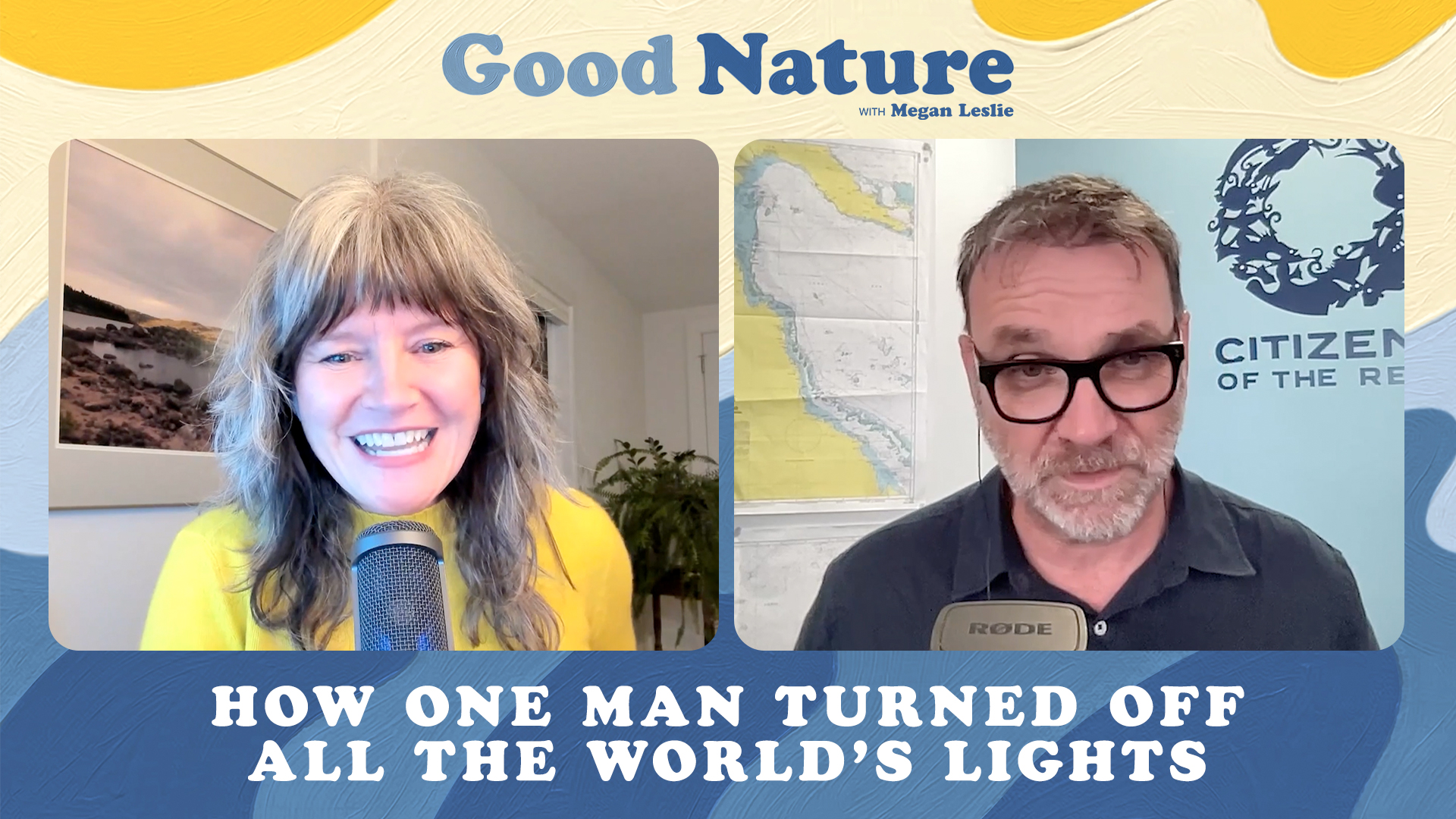
Today's guest is Andy Ridley. Now two days after the release of this episode, we'll celebrate Earth Hour. And this year is the 20th annual Earth Hour, the global event where people around the world turn off the lights as a symbol of climate action. Way back in 2007, Andy helped bring that simple idea into reality and it has taken on a life of its own over the past 20 years. These days, Andy's focused his attention on bringing people together. To protect coral reefs through his organization, Citizens of the Reef. Andy believes so strongly in the idea of collective action, how lots of people can take simple actions together to make real change. And I found his observations really inspiring. It gave me hope about how we can take action on the solutions that we know are out there. I had a lot of fun chatting with Andy about that first extraordinary Earth Hour. The way the environmental movement has evolved over the last 20 years, and the unique world of coral conservation. I hope you enjoy it too. But first, let's go to a segment I like to call Tell Me Something Good.
Now, it can be hard to stay hopeful these days, so I wanna call up some of my amazing WWF Canada colleagues about the things happening in their world that give them hope for the future. So today, I'm calling Ryan Godfrey, WWF's Canada's resident botanist. Let's call him up on the Orca phone and see what's going on in his world. Okay, Ryan, tell me something good.
Ryan Godfrey [00:02:50] Hey, Megan, how's it going? Great, I got an orca phone. Fantastic, it's a great day for some great news, I think. But first, I have a question for you. In your garden, in your neighborhood, would you say that there are any weeds around there?
Megan Leslie [00:03:06] It's one of the reasons I don't garden. I mean, it's just like this constant battle against weeds and I am not up for it
Ryan Godfrey [00:03:14] So here's the good news, Megan. I can disappear your weeds in an instant. No chemicals required.
Megan Leslie [00:03:21] WHAT
Ryan Godfrey [00:03:22] That's it, yeah, are you ready for it? I am, tell me about it. Okay, so I'm gonna do this in a tricky way with semantics, because the fact is, there is no such thing as a weed. It's not a botanical term, it's not scientific term, it has everything to do with context.
Megan Leslie [00:03:36] Hang on, but I have, I definitely have weeds in my yard.
Ryan Godfrey [00:03:41] You just have to think about them in a little bit of a different way. See, if you learn the name of the plant, maybe learn where they're from, learn some of their functions, maybe that plant is edible. Maybe that plant is important for pollinators. Maybe that plant is good at bringing carbon down into the soil. And once you learn a little bit, then you might want to keep the plant. And as soon as you want it there, it's no longer a weed. It's just a neighbor.
Megan Leslie [00:04:06] I get it now. Amazing. So is that all weeds? Ahem. Plants?
Ryan Godfrey [00:04:12] I think that every plant deserves, you know, to be understood a little bit here and there. And you know once you learn about the plant and if you were to learn for example that this is an invasive species, probably do want to pull it out. But a lot of plants that people identify as weeds, turns out when you learn a little bit more about them, that might actually be a native plant species. Or it might be a naturalized plant that isn't doing any harm in the ecosystem and probably has some uses for either you or the wildlife that's living nearby.
Megan Leslie [00:04:41] Well, Ryan, that really is something good. Thanks so much.
Ryan Godfrey [00:04:45] Cheers!
Megan Leslie [00:04:50] Okay, our guest today is Andy Ridley. Now, 20 years ago, he co-founded Earth Hour. Andy, it's okay. I know it's a while ago, but it's exciting. We're celebrating. Earth Hour is the global movement in which millions of people turn off non-essential lights for one hour to raise awareness for climate change and habitat loss. More recently, he founded Citizens of the Reef, an organization that encourages regular people to work with new technology. To help protect the world's reefs. Andy, welcome to good nature.
Andy Ridley [00:05:23] Oh, lovely to see you.
Megan Leslie [00:05:26] Oh, we're so glad you're here. First of all, where are you joining us from today?
Andy Ridley [00:05:30] I am in Cairns, which is the northern end of Australia, so just off the Great Barrier Reef. The Great Barriers Reef is just over there.
Megan Leslie [00:05:39] I can picture it. I'm in Ottawa, Canada, and the Gatineau Hills where I go cross-country skiing is just over there.
Andy Ridley [00:05:46] Yeah, let me tell you, the weather is slightly different, I think.
Megan Leslie [00:05:49] I think so, and so is the time zone. I mean, you can probably see it's a little dark over here through my window.
Megan Leslie [00:05:56] So we're recording this on Thursday at 7 p.m. My time. What about you?
Andy Ridley [00:06:01] It is just after 10 o'clock in the morning on Friday, and let me tell you, your Thursday night's gonna be fantastic.
Megan Leslie [00:06:08] Oh, thanks for the heads up. Yeah, okay, good, good. You’re calling me from the future! Andy, look, you co-founded Earth Hour back in 2007, and we kind of alluded to this in the intro. I can hardly believe it's the 20th anniversary of Earth Hour. So, first of all, congratulations. It's amazing. But going back 20 years ago, tell us about where this idea came from.
Andy Ridley [00:06:30] I can't believe it's 20 years ago, it makes me feel very ancient, but we had a very climate skeptic government in Australia in 2006, 2005. I'm not sure sometimes politically whether the world's in a better place at the moment, I don't think it necessarily is, but at the time, one of the things that we kept hearing was that the electorate here in Australia didn't really care about climate. Change or the issue and that you know I think a lot of the stories around it was it's all too big to do anything about and you know all the stuff that we continue actually to hear from all over the world with many politicians. I was working for WWF Australia and I think we just got a bit cranky about the fact that everyone kept telling us that no And, you know, one of the things with WWF at its best is it can mobilize. Across a very broad spectrum of community. And I think what we thought was, well, how do we do that on this issue? And how do really, almost in a sort of politically neutral way, just go, no, actually the majority of people really do care and they really wanna see action. And I the last piece of that was really, okay, we have tried a lot of things. So we had won some really big outcomes for things like the Great Barrier Reef for big rainforest stand in Tasmania. Lots of stuff like that, but we were really not scratching the surface on the climate change debate. So we tried one campaign, it had failed, but what we learned from that was, or the kind of lessons we took from that were, firstly, maybe this thing called social media might be quite useful to connecting lots of people. So at the time, I think MySpace was just, was certainly the biggest social media platform in the world.
Megan Leslie [00:08:13] Oh, Myspace, yeah, yeah.
Andy Ridley [00:08:15] I'm still on it by the way, and no I'm not.
Megan Leslie [00:08:17] Good for you, you and all four people.
Andy Ridley [00:08:21] Yeah, yeah, exactly. So it was a bit of that, but there was also the idea, at the time at least, that was we needed hope, not fear. And that consistently that we were running campaigns that were really a fearful message, and that we would just consistently not getting cut through anymore. And then the idea of the lights out really was it was actually started as a bit of a kind of petulant idea. It was that we will try and turn all the lights off in Sydney, apart from the ones in Kirribilli where the Prime Minister lived. And that was originally where we started. Yeah, yeah, so we were sort of playing around with originally quite negative campaigning ideas. I actually had a lunch with this journalist who's the head of one of our big newspapers. By the end of that lunch, we'd come up with this idea that was much more about hope, not fear. It was much around, how do you bring a whole city together? And that's what we did though, in 2007. We stood on the side of the Sydney Harbor and. Also, I'd given up smoking about two months beforehand. So I was particularly nervous, cranky, anxious, all these different things, all these emotions at the time. But then it kind of, we'd put a lot of work into trying to engineer the lights to go off in lots of buildings. But then when it actually happened, it was amazing, you know? We're sort of standing there on the side of the harbor. And I guess we thought that the lights would go off in one go. But actually what happened is, it started the big billboards on top of that building started to go off and then the hotel started to turn off and you could see all houses and flats and all this all around the harbor turning off. And then the bridge went off, our famous Sydney Harbor Bridge, and then The Opera House went off. And we just stood there with this sort of bizarre Batman-esque kind of sky. And you just look around and there were thousands of people across Botanical Gardens having candle-lit picnics and, you know, in the end, this whole city kind of. Came to the party and went, right, yeah, we want to show what we're doing. And then the next day, the city of Toronto rang us up and said, we want to do Earth Hour in a month's time in Toronto. And we went, well, it took us many months to do it, but why don't you announce as being the first city to join Sydney for 2008. So that's, that's kind of how it went.
Megan Leslie [00:10:28] Oh my gosh, thank you. I mean, I'm getting a little misty eyed. I feel like you really painted a picture where I felt almost like I was there too. I can picture it. And so sharing with us what it was like on that day, let's sort of fast forward a bit. What was it like to, you know, it's a simple idea. Let's turn off the lights for an hour. But you have watched it spread, not just across Sydney, but around the globe. What has that been like for you?
Andy Ridley [00:10:56] I didn't really realize what we'd done until I left. Okay. Like a lot, lot later really. And I think that the biggest thing was, well, there was some amazing stuff. First thing was it was amazing to see other parts of WWF around the world go, can we do this together? Yeah. And there is this extraordinary power when you get the sum of all the parts working. Like, and I don't really, I didn't really realize that till maybe a long time later, but I sort of look at it now and I guess that what we work on now is all about how do you get the sum of all the parts to create something much, much more effective, powerful that can deliver outcomes. So I think that's kind of one of the big things that I walked away with from it. But I think, you know, when in dips and dives, you never really, we know, I don't think there's any point that I thought we were really successful. It was sort of bizarre, but the first year was one city, the second year was 370-something cities. And then the third year was 5,000 cities. Rollercoaster.
Megan Leslie [00:11:51] Yeah, and one of the things, absolutely a roller coaster. And at the same time, so keeping at it, you know, that consistency is really important. And when I think about Sydney Opera House, the CN Tower, the Eiffel Tower going dark, powerful, powerful visual symbols. And yet at the same time. You can be at home and just turn off your lights. And it's this super low barrier way for anyone to join in. And I've been involved in, well, in my own house, even when I started at WWF, we were at this local pub and the pub lit candles and turned everything had an acoustic guitar for the hour. So it's really interesting that it is such a low barrier threshold to participating. And I wonder how you've seen this event, the big symbolism of it, but also with the individual actions, Have you seen? This symbolic event spark action.
Andy Ridley [00:12:46] I did my last, as the person running it I guess, I did my last one in 2015 so after that I just do it at home with my kids.
Megan Leslie [00:12:56] Yeah
Andy Ridley [00:12:57] or in a field somewhere, so that's kind of, or on a boat. But what was amazing about, like when we started Earth, even the date was designed so that it would hit when you could get the most amount of countries to be dark at eight o'clock local time. So it was around the equinox kind of date. So even at the beginning we go, imagine if this works, we'll need to think about the timing. What was interesting about it was when we were starting to think, well, how do you take this beyond the hour itself? Because when you start something like this, you go like, imagine if everyone would turn the lights off for an hour. And imagine how that might resonate emotionally and how a sense of togetherness and all that. But what we kind of started to realize was, oh my God, we've lit something here. Something amazing could happen. Like, how did you utilize that? And I remember the last year that I worked on this project. Probably the much more satisfying thing was the fact that so many people all over the world had adopted the Earth Hour kind of movement and were using it to further their own conservation outcomes locally. Yes. Yeah. All over the place. And I know it was happening in Canada, but it was in Colombia and in Philippines and in Indonesia and in Brazil and in Argentina and the UK. You know, so what, what that gave. What I thought was the most rewarding part of that was this idea that there are millions and millions and millions of people all over the world who, given the opportunity, given the sense of common purpose, will get behind you if you can work out how to self-organize. So that for me is like scalable conservation in the 21st century. We will be waiting forever to get billions and billions of dollars off government. How do we start to mobilize our communities on a mass level?
Megan Leslie [00:14:38] Yeah, you know, it's been wonderful to see how this has really been adapted, how it's evolved and how it has been adapted in different contexts, different countries, different regions for different outcomes. I mean, here at WWF Canada, we asked people last year, just get outside in nature for an hour. Just go connect with nature, you know, and think about what that means for you and Habitat, you know, impacts on Habitat. I've seen mass petitions. Uh, signed for Earth Hour. I've seen parks being announced, uh, for Earth Hour after lots of citizen engagement. And it's this real, you've tapped into this way that people can take action and convert their desire for change into actual change. [00:17:11] Now I want to, speaking of learning, I want to learn a little bit about what you're doing right now and, uh, share with our listeners because you are doing hands-on conservation with your organization, Citizens of the Reef. And this is all about protecting the world's coral reefs by encouraging local community members and virtual volunteers to help monitor them. And I have to admit, when I read that it sounded really technical and very intimidating to me, but also very intriguing. Because it's not specialists doing this work, it's community. So a little bit like lights out, people getting involved, but tell us more about this. Who are the people monitoring these reefs and how do they do it?
Andy Ridley [00:17:53] Yeah, so at the risk of sending you to sleep, I'll give you a little bit of back story, which was we had on the Great Barrier Reef these two sequential mass bleachings. So very high mortality of coral caused by basically hot water coming across the reef. And then it happened again. So yeah, 2016. Then it happened in 2017. And it was really high mortality, so a lot of coral died. And it just wasn't used to stress of those conditions. And there was this kind of emergency conference that was pulled together, which included everybody. So tourism, traditional owners, marine operations people, the Marine Park Authority, everyone. And it was a crisis conference held in July 2017 in towns also, just a bit south of where I am now. And there's a big conversation about what we're gonna do. And we all know that the big threat is climate change, but we also know that resilience on risk can be improved by. Better local management, and maybe that buys us some time. So that's kind of the, I guess, the framing. And one of the things that came out of that conference was when you're looking at an area as spatially large as the Great Barrier Reef, and to give you an idea here how big it is, because I'm sure you all know it's big, but if you put it alongside the west coast of the US, it would go from above the border with Canada to below the border of Mexico. Wow. So when you think of scale, it's the same spatial area as Japan or Germany.
Megan Leslie [00:19:13] I didn't realize that.
Andy Ridley [00:19:15] Yeah, so even I like I knew it was big, but it's bloody big, right? So, so when you're looking at that a lot of the decision-making is based on modeling Okay, so and that's based on very small survey sizes very Professionally done but small survey size is so there was this sudden need to see because you're having these things happening across massive areas So when the bleaching happened it happened across like half the roof So the demand came back for we need broad-scale reconnaissance imagery, understanding across this whole of the system. So we were like, okay, well, how are we going to do that? Because we'll never have much money, and we need a flotilla of research vessels. We need lots and lots of imagery from very remote places. So actually taking the Earth out model, we went, okay well, can we build a motley flotiller out of all the different boats that run up and down the reef, almost like a Dunkirk flotillar. And so we did, and the first year we really ran it was the first of year of COVID. So, Cairns is a tourism town, generally. It's the gateway to the Great Barrier Reef. But during COVID, obviously, there was no tourists, and so it was a bit of a ghost town. But all the boats that go out to the reef still had to run their engines. So we went, right, let's build the flotilla out of everyone that's got a, you know, that's not been used. And that's kind of how it happened. And the first year we got to 160 reefs. The second year it went up to over 200. Now there's... More than 100 vessels involved. They range from tugs to super yachts to dive boats to recreational fishing boats, all sorts of stuff. T.O. Ranger boats, traditional owner ranger boat. And that community up and down the reef goes out, captures data, and it's really simple how to do it. It's like you use a GoPro, two of you in the water, take 40 images each on a GoPro once every five fin kicks. So it's designed to work for Australians. It's really simply. And then we built a system behind that. Because what was happening was people might actually get the photographs, but then trying to get the photograph out of those GoPros was really hard. If people come home, they go to the pub or they would go home to their family. And yeah, so we built this whole system to go, right, we come out of the water upload really easy. What it's actually starting to do is to show like, where are the most important reefs we call, the scientists call them key source reefs. Our traditional owners call them mother reefs, which is a far better term. But these are the reefs that reboot the ones around them. They're really important in terms of building resilience and protection. And so this whole project has been identifying those key source reefs or those mother reefs. It has changed the whole modeling for the Great Barrier Reef dramatically. Wow. But I think 88% of reefs changed their prioritization off the back of this. It's been going now for, we've just completed capturing survey data for the sixth census and it gets kind of bigger every year. And the project has now been adopted in other places around the world. So it starts in the Red Sea in a few months time, and it'll start in the Coral Triangle in April with local WWFs, believe it or not.
Megan Leslie [00:22:15] Yes, this is what I heard that you're working with other WWFs!
Andy Ridley [00:22:19] Amazing!
Megan Leslie [00:22:22] And I love that you actually call this the Earth Hour model. Can I ask you, in the spirit of continual improvement, were there lessons from Earth Hour where you were like, oh, we should try it this way, or in how you execute it?
Andy Ridley [00:22:37] I think the first thing with Earth Hour was the one challenge that we had with Earth Hour, even going beyond the hour, was that the name defines it as an hour.
Megan Leslie [00:22:45] Oh, oh, yes.
Andy Ridley [00:22:46] So, just sort of think of one of the things we sort of thought about with that is if you've got millions and millions of people who actually care and want to do something, don't restrict them to an hour, do more, right? So that's kind of what, probably the really big, that's a brand one. But the other one is that I think one of biggest lessons out of Earth that was The amount of people who tell you something won't work. Oh, it won't work in my country or it won't t work in my city or it will work. And then you realize that actually most people, we have a, we, we share a commonality. Yeah. Um, and particularly people who have, uh, some love for nature. It doesn't matter where you are. It doesn't matter if you're in Zimbabwe or if you' re in Australia or if your in Canada is my suspicion or Columbia or whatever, you know, it is all about people who, if you, people who appreciate and love nature are an amazing engine room for all of this stuff.
Megan Leslie [00:23:38] Oh, this is good. You know, like I, I lead WWF Canada and I am here for the teaching, right? Like, what can we learn? What have other people experienced and we can learn, uh, to help our conservation projects succeed. So I love branding. It sounds like a simple little thing, but yes, why would we limit ourselves?
Andy Ridley [00:23:56] One of the cool things that we've been working on. So we have a thing called the Reef Cooperative. So if you think of, we have a virtuous circle, so if you've got to get data out of the water, the whole community gets involved. It doesn't matter who you are, anybody can help. Then it gets analyzed by virtual volunteers all over the world. So that's using a combination of AI and the human eye. Then those insights get interpreted by managers and by scientists to go, okay, well, this is what that means and this is what we should therefore do. The last piece of that, though, sort of brings it all the way back, which is, how do you build a workforce on a reef? So in Australia, we have a term tradies, like, so if you've got an electrician who comes around, it's a tradie, right? So we've been thinking about this idea of, like can you have essentially reef tradies who are really good at restoration, who are good at management, managing pests on a reef, who a good at monitoring and evaluating, who ... You know, are the driving force locally of both the stewardship and the protection and the restoration of reefs wherever possible. So there is this whole thing of this virtuous circle. When this works out its best, the coolest thing about it all is You've got people from all walks of life helping to make this work. And most of them have never been to the reef, right? So all the virtual people, most of the have never being anywhere near a reef. You've go expertise that range from AI engineers to conservation marine biologists, to traditional owners who know their sea country, to fishermen, to, you know, there is a very interesting collective approach there that- No kidding. We always talk about it as like being the 21st century conservation model, Which is, we can't do it on our own. We're probably not we're not talented enough to do it on our own. So how do we get the talent to help us?
Megan Leslie [00:26:18] So Andy, you've got Earth Hour, Citizens of the Reef. These are major touch points in your career and they're both about bringing large groups of people together to work towards this common goal, right? And you know, same time I talk to folks and sometimes they have a lot of anxiety about the environment, so much anxiety that sometimes they feel paralyzed. They, they don't know how to act. They get overwhelmed. You've been, I've read some of your work where you talk about give people something to do. Give people an action that they can take and they will and these individual actions have really added up to real impact and you've inspired people to take these actions. So I want to ask you, you're inspiring a lot of people, but what inspires you to do this work?
Andy Ridley [00:27:04] It's very kind of you to say that stuff. I think actually the people are the most inspired people, we have a lot of heroes. So the whole thing with Earth are no single hero, right? Yes. So that's a really, really critical thing. You have a hero in your community, it could be a kid in a classroom, it can be a CEO, that's basically the idea. It's like you don't put the focus on any single person or even single organization. I think WWF was very courageous to let us create. From within WWF, the Earth Hour brand, that was really open to everybody. The engine behind it was WWF and I actually thought that position was really interesting because it meant we were not claiming we knew how to do everything, we were just going, how about you come and help us do something? And it's a really different vibe, right? Yeah, yeah. There was this girl who in the first year of Earth Hour, her name was Paris Rains and she worked, she was a young kid, like 11, 12, I guess, at the time and she became known as Climate Girl.
Megan Leslie [00:28:06] Okay, that's a good name.
Andy Ridley [00:28:07] Yeah, but she did all this campaigning around climate back in 2007, 2008. She became a big hero of ours. But yeah, she was like, we were all super inspired by her. She was like this little dynamo. And quite weirdly, about four weeks ago, she came to a vent of ours, obviously much older now, 20 years on. But she came into a vent and she connected us with a new partner that's working on some engineering AI stuff with us. And it's like, yeah, these people, these heroes that you meet in your job are That's what gives you persistence and makes you want to do it. And yeah, I don't know. It's probably a bit of a rubber shot. So, but it was kind of cool. I think it's all these people that you kind of end up hanging out with to do this stuff.
Megan Leslie [00:28:47] Yeah. Now, Andy, I do have a little bit of a surprise for you because on this show, we end every interview with a lightning round, a series of questions that we call the trail mix or maybe the out on a boat on a coral reef mix. Got it. So I'm going to ask you some quick questions and you got to give me some quick answers. Ready?
Andy Ridley [00:29:10] Oh, you've seen I do really short answers, right?
Megan Leslie [00:29:13] You're gonna be great at this. I believe in you.
Andy Ridley [00:29:17] Okay, go.
Megan Leslie [00:29:18] Okay, in your opinion, best Australian animal.
Andy Ridley [00:29:21] Okay, I would say, I'm gonna give you lots. Tree kangaroo, crazy. Okay, kangaroo lose up a tree.
Megan Leslie [00:29:30] Didn't know about it, I'll look it up.
Andy Ridley [00:29:32] Cassowary, it's like an emu that looks like a dinosaur a platypus. Yes. It's got a bill at both ends and lays eggs and has poisonous spikes on its front feet. Yes and then finally I'll give you a marine one which is not exclusively here but is one of my favorite animals we ever see over here which is the cuttlefish or as my kids sometimes call it, the cuddle fish, but yes.
Megan Leslie [00:29:58] Great answers, great answers. Now, tell me your favorite fact about coral.
Andy Ridley [00:30:04] I don't want to send the wrong message here, I am astonished by its resilience. I'm astonished that it's still hanging in there. And in some places it's, you know, you can still go on the great barrier reef and see absolutely extraordinary places, places that will blow your mind. Everything that we do to build resilience and buy them a bit of time, even forgive nature, just that smallest opportunity. It has incredible fire in it, and so coral is a good sign of that.
Megan Leslie [00:30:45] Andy, what's the best advice you've ever received about working in conservation?
Andy Ridley [00:30:50] I would say the best advice I have been given and probably would give as well is that conservation isn't just for conservationists. Your, and I was sort of referring to this earlier on, is the kind of talent that you need to really change the world for the better in conservation goes well beyond our comrades that we work with on a daily basis. And we need everyone in that mix. But the upside to that is you'd be surprised how many people who wouldn't necessarily build themselves as conservationists are ready to help.
Megan Leslie [00:31:25] Hard agree. Okay. Say World Wildlife Fund in your best Canadian accent.
Andy Ridley [00:31:34] Okay. All right. That's challenging. [00:31:43] Okay, let me try. So we're world world world. This is going to be resists mildly kind of rubbish.
Megan Leslie [00:31:51] I'll do Australia after to boost you.
Andy Ridley [00:31:54] I do believe it's the World Wildlife Fund.
Megan Leslie [00:31:58] Oh my gosh, you really were...
Andy Ridley Do I sound like I'm from Canada?
Megan Leslie No, you sound like you are from the southern United States. That's amazing. That's amazing.
Andy Ridley [00:32:05] I did warn you. I will try. I feel naturally at home there for a second, Diana.
Megan Leslie [00:32:12] World Wildlife Fund.
Andy Ridley [00:32:16] Mate, you sound like you're from around here.
Megan Leslie [00:32:19] Oh my gosh, yes! I'm like F-A-H-N-D, fand. Fand. Fand, fand, I got two more for you. If you were a type of coral, what would you be and why?
Andy Ridley [00:32:35] One of my team and her mum just found what we think is the largest colony of coral on the Great Barrier Reef, but certainly the largest that we found, and probably somewhere up there in the top two or three in the world, and it's a type of coral called Pavona. This is amazing, it's like, how do you even describe it? It's like these kind of little fingers, about millions and millions and And within each of the fingers, they're all quite tightly compressed like this. Within that is massive colonies of clownfish, you know, nemos and various other things. So yeah, that was probably my, I went, I was lucky enough to go diving there with Sophie, who discovered it with her mum, and I took my youngest son. And yeah, it was definitely a bit of a special moment. And it's an incredibly beautiful sight to see it. So that's, you, know, amazing, healthy coral.
Megan Leslie [00:33:40] What is one thing everyone can do to protect the ocean?
Andy Ridley [00:33:44] Well, a shameless, shameless plug for what we need. Yeah. So, I was talking before about capturing all these images that come from the Great Barrier Reef and now are coming from Coral Triangle and Red Sea and Hawaii and various other places. We are trying to identify the key source reefs, the mother reefs. And to do that, we need thousands and thousands of images analyzed. And we've built this platform to allow you to do it at citizensgbr.org. And you can just jump on and it takes, when you get good at it, it takes just a few seconds to analyze an image and you're assisted with AI. So yeah, if you have time, if got 10 minutes, if you're sitting on the bus trying to get to work or on a train or if you are sitting on a sofa watching TV. To multitask. Yeah, yeah, yeah. Do some analysis so you can restore your karma.
Megan Leslie [00:34:32] Amazing. Well, on behalf of all of us at the World Wildlife Fund.
Andy Ridley [00:34:38] And Canada. You got it.
Megan Leslie [00:34:41] Thank you. Thank you so much for joining us. Really great to meet you. Thanks for joining us on Good Nature. It was such a delight to talk to you.
Andy Ridley [00:34:49] It was a total pleasure. Thanks for your interest. I really appreciate it.
Megan Leslie [00:34:56] Thanks for joining me today on this first episode of Good Nature. I'm so happy that you're here. Now, if you have any thoughts, ideas or questions to share, leave a comment or you can leave me a voice message. Just go to speakpipe.com slash WWF Good Nature, the link will be in the episode description and I can't wait to hear from you. For more news about Good Nature you can subscribe on YouTube or wherever you get your podcasts and sign up for our newsletter, it's great. Living Planet News. The link for that will also be in the description. See you next time.